ABOUT THE PROGRAM
Agricultural and Biosystems Engineering is the discipline that deals with the design, production, utilization and management of technical means and processes for the production, storage, treatment and processing of agriculturally based goods and services.
Agricultural Engineering undergraduate curriculum in the Federal University of Technology, Owerri came into effect in the 1982/83 academic session. In line with global technological requirements and advancements, the department’s curriculum was upgraded in line with today’s realities in the Engineering field, and in 2014/2015 academic session, the University Senate approved and enhanced the curriculum and a new name for the department (Agricultural and Bioresources Engineering). The senate in her 503rd meeting approved the change of nomenclature of the Department to Agricultural and Biosystems Engineering in compliance to the prerequisite of CCMAS. The undergraduate Programme in Agricultural and Biosystems Engineering is for a minimum duration of five (5) academic years and a maximum duration of seven (7) academic years. Upon completing the Programme and fulfilling other University requirements, a Bachelor of Engineering Degree in Agricultural and Biosystems Engineering
(B.Eng.) is awarded. This is tailored to providing an Engineering education that cuts across many other related fields of engineering (Mechanical, Civil, Electrical and Electronics, Chemical) and their applications in the agro-food and biological industries. This is because Agricultural and Biosystems Engineering is an integrating discipline that tries to realize and implement ideas identified as useful and necessary by other disciplines. In a bid to strengthen interdisciplinary cooperation and taking into account the agricultural development needs of Nigeria and the type of job expected to be done by the graduate, the curriculum is fashioned out to achieve the following results.
- Sound foundation training in a broad spectrum of basic engineering courses and inculcation of cutting-edge/emerging technology in the various areas associated with agricultural and biosystems engineering as a profession.
- Delivery of a well-articulated training programme that retains by the special choice of courses the principle of specialization in its broad sense while attaining at the same time general training in the core areas of Agricultural and Biosystems Engineering profession.
- Adequate practical training aimed at the production of graduates who are practically oriented and are finished products. This is achieved in the curriculum by a twelve (12) months practical industrial experience (SIWES) programme that spans from the second year to the fourth year of the degree programme.
The choices of the final year projects of the department are designed to provide practical solution(s) to real problems of agricultural production, processing and the utilization of agricultural products and ameliorating water and soil conservation problems in agriculture. To this end, practical training in the field combined with laboratory experiments and the graduate’s ability to utilize the various workshop tools are used to actualize concepts related to solving agricultural problems and challenges.
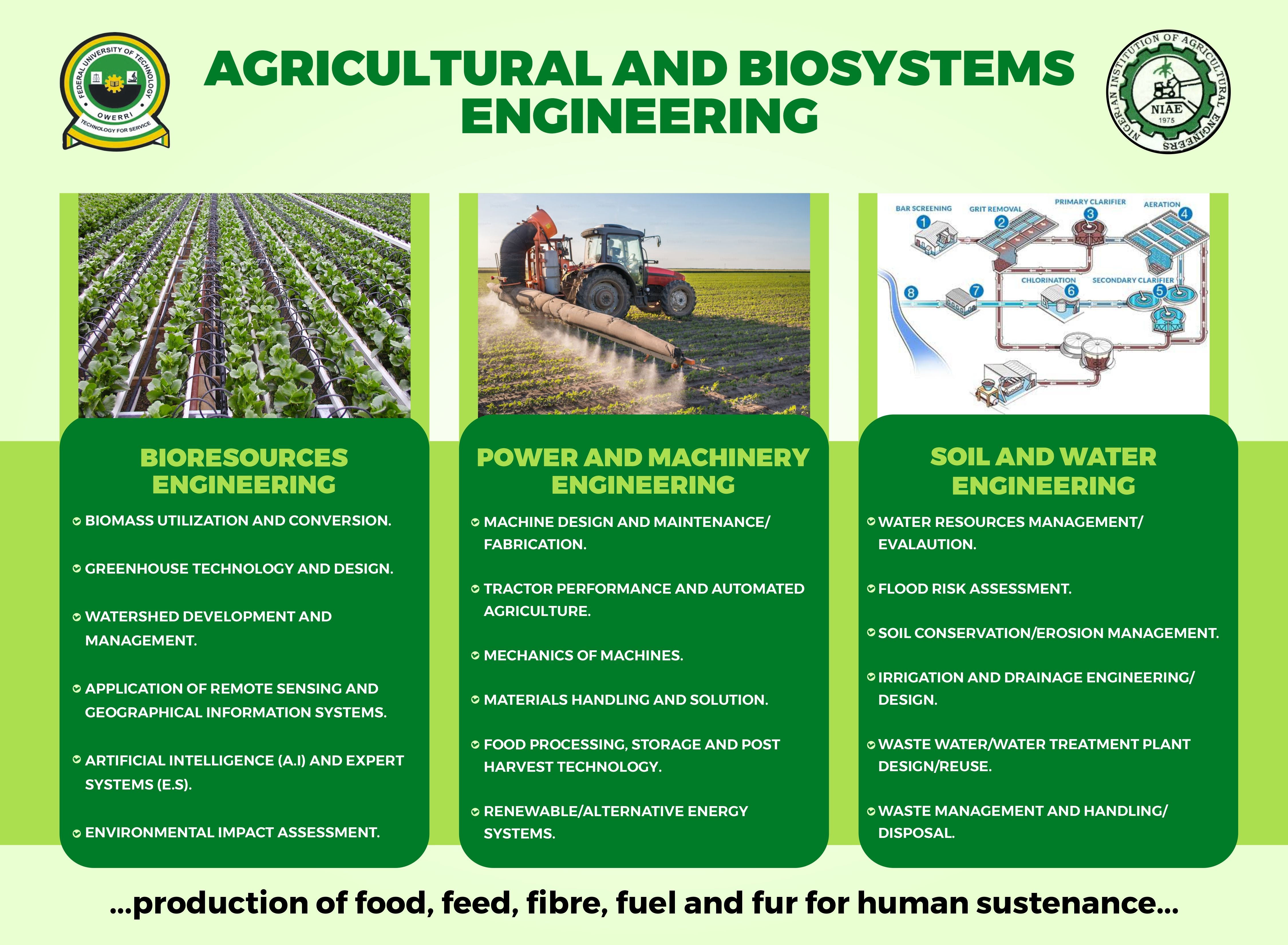
The Department presently offers B.Eng in three options namely;
- Power and Machinery Engineering (PME)
- Bioresources Engineering (BRE)
- Soil and Water Engineering (SWE)
Additionally the Department offers postgraduate diplomas (PGD) and postgraduate degrees of M.Eng and Ph.D in the above areas of specialization.
THE VISION STATEMENT
The vision of Agricultural and Biosystems Engineering Department of Federal University of Technology Owerri, is aimed at fostering long life learning through blending expertly a focus on teaching and research through openness and diversity of thought, experience and culture culminating in the graduation of highly sought leaders in Agricultural and Biosystems Engineering.
THE MISSION STATEMENT
The mission of the Department is to educate the next generation of professionals and discover new/emerging technology in Agricultural and Biosystems Engineering; disseminate cutting-edge research-based engineering information and recent technologies through the media and outreach programme; and conduct all programme(s) in the context of a world class university and deliver the highest value knowledge to our students, citizens and global society.
PROGRAMME OUTCOMES (POs) OF THE AGRICULTURALA ND BIOSYSTEMS ENGINEERING DEPARTMENT
The Programme Outcomes (POs) of the Agricultural & Biosystems Engineering Programme in the Department of Agricultural & Biosystems Engineering, which are published in the student handbook, ensure that all graduates receiving a B.Eng. (Agricultural & Biosystems Engineering) degree from the Federal University of Technology, Owerri:
- Apply knowledge of mathematics, science, engineering fundamentals and engineering specialization to the solution of developmental and complex agricultural & biosystems engineering problems (Engineering Knowledge).
- Identify, formulate, research literature and analyze developmental and complex engineering problems reaching substantiated conclusions using first principles of mathematics, natural sciences and agricultural & biosystems engineering sciences (Problem Analysis).
- Proffer solutions for developmental or complex engineering problems and design systems, components or processes that meet specified needs with appropriate consideration for public health and safety, cultural, societal and environmental considerations (Design/Development of Solutions).
- Conduct investigation into developmental or complex problems using research-based knowledge and research methods, including design of experiments, analysis and interpretation of data, and synthesis of the information to provide valid conclusions (Investigation);
- Create, select and apply appropriate techniques, resources and modern engineering and ICT tools, including prediction, modelling and optimization to developmental and complex engineering activities, with an understanding of the limitations (Modern Tool Usage).
- Apply reasoning informed by contextual knowledge, including Humanities and Social Sciences, to assess societal, health, safety, legal and cultural issues and the consequent responsibilities relevant to professional engineering practice (Engineer and Society).
- Understand the impact of professional engineering solutions in societal and environmental contexts and demonstrate knowledge of and need for sustainable development (Environment and Sustainability).
- Apply ethical principles and commit to professional ethics and responsibilities and norms of engineering practice, including adherence to the COREN Engineers' Codes of Conduct (Ethics).
- Function effectively as an individual and as a member or leader in diverse teams and in multidisciplinary settings (Individual and Team Work)
- Communicate effectively on developmental or complex engineering activities with the engineering community and with society at large, such as being able to comprehend and write effective reports and design documentation, make effective presentations, and give and receive clear instructions (Communication).
- Demonstrate knowledge and understanding of engineering, management and financial principles and apply these to one's own work as a member and leader in a team, to manage projects (including product commercialization) and in multidisciplinary environments (Project Management and Entrepreneurship).
- Recognize the need for, and have the preparations and ability to engage in independent and lifelong learning in the broadest context of technological and social changes (Lifelong Learning).
PROGRAMME EDUCATIONAL OBJECTIVES (PEOs) OF THE AGRICULTURAL AND BIOSYSTEMS ENGINEERING DEPARTMENT
The programme educational objectives (PEOs) of the Department of Agricultural & Biosystems Engineering, Federal University of Technology Owerri, ensure that Agricultural & Biosystems Engineering graduates working in the engineering profession reflect the Agricultural & Biosystems Engineering Graduate Attributes. It is expected that our graduates will achieve one or more of the following PEOs within the first three (3) to five (5) years of their graduation from our programme in line with the engineering application and knowledge attributes of the Profession.
PEO 1 - Preparation
Be established and recognized as a valued engineering professional and an effective communicator in industries, academia, research institutions, government ministries, departments and agencies (MDAs) related to Agricultural & Biosystems Engineering, as well as related engineering technologies.
PEO 2 - Skill acquisition and Collaboration
Practice the Agricultural & Biosystems Engineering profession and apply scientific principles to the design, operation and maintenance of engineering systems and devices in a collaborative team-oriented manner that embraces the multi-disciplinary and multi-cultural environment of present-day society.
PEO 3 - Application
Engage in lifelong learning and professional development with proficient soft skills, creative, innovative, and readily further develop entrepreneurial skills and technical competence to be self-employed in consultancy, manufacturing or service industry.
PEO 4 - Professional
Function as a socially, morally, and legally responsible member of society with willingness to mentor fellow employees and understand the ethical, social and economic impacts of their work in a global framework.